General outlook


Wurthymp Wood is a 17 acre / 6.9 hectare plot, divested from a mixed woodland 30 acre farmland project planted by others in 2006.

From 2014 it has stood as a stand-alone woodland conservation project in a wider landscape mosaic.
The woodland is privately owned and funded and is run on a break-even sustainable basis, resources are shared with the Meadowcopse Orchard Project a few miles to the north.

The primary objectives are mixed:-
a, Wildlife habitat conservation (trees, grassland and ponds).
b, Rotational coppice woodland management (thinning, regeneration, rural craft materials and firewood).
c, Selective long-term forestry tree management (coppice with selected standard trees left long-term).
d, Community, education & research engagement, (the promotion and understanding of wildlife & sustainable conservation in a wider landscape context).

Wednesday, 30 August 2017

August 2017

A busy few months both at home and at the woods, which left an unintentional gap on monthly woodland blog updates.
A couple of away-days too, particularly facilitated by Smallwoods at Ironbridge / Coalbrookdale, as well as attending a couple of country shows that have a reasonable environmental aspect and a return visit to the Bulworthy Project woodland in Devon.


Back in the woods, a bit of species and wildlife spotting and some preparations prior to the reintroduction of seasonal grazing in a couple of areas.
Quite a few dragon and damsel flies around this last month, but only managed to photograph what i think is a Red Darter...


Some steady work on the Public Footpath that passes from Worthenbury to Threapwood through the woods - after some positive dialogue with the Council Rights of Way Officer, who was looking at issues elsewhere in the village.
A narrow wooden bridge over the central ditch was getting a bit dilapidated and slippery in the winter months.
Longer term plans are to mow the path at a wider width between the trees, together with coppiced / shrub layer sides for greater light and shade variation and ultimately a wider range of species biodiversity.
To make access safer and to be able to pass through with the mower more easily, a culvert for the ditch has been put in place of the narrow wooden bridge.


Ditch culvert prior to backfill


Sadly a few visitors along the Public Footpath have not been too respectful of their surroundings...
The plastic packaging strip in the photo below, is about the most damaging litter for wildlife that can be left lying around. Too easy for small mammals and birds to get trapped, but not easy to get out of.

A couple of folk have been wandering off the path too.
The woodland is private land with no concessionary access (unless by prior arrangement).
A couple of times dog walkers have been asked to put their dogs on a lead whilst away from the path. I won't accept "Oh, they are alright." They aren't!
They should be under close control along the path and preferably on a lead when seasonal grazing livestock are on site. Importantly, there are a colony of hares in the woodland and it is mainly for this reason people are respectfully requested to keep to the Public Footpath and their dogs under control.


One of the hares on the woodland margins.


With the risk of coming across all "Get orff my laaand..." Someone has been practicing bushcraft skills in the woods. Great that youngsters are out and about in the natural environment, but some discussion beforehand would have been appropriate before building a den.
A little annoying that some fencing materials had been used from in the middle of a job, but also it has been put up right in the middle of an Ash Die back disease area. Although this tree disease is mainly spread by spores airborne, trampling through the fallen leaves increases the risk of spread - particularly to other woodlands via footwear.
People should ask before wandering in and doing stuff like this.


Quite a few Common Blue butterflies around earlier in August.
A proportion of the woods is managed as traditional grassland / meadow for biodiversity (11 years ago it was open fields before the trees were planted).


Mowing for hay is helping re-establish grassland plant diversity.
Noticeable are knapweed, birdsfoot trefoil, cuckoo flower, vetch and cowslips. 
Thanks to the neighbour for doing the mowing and putting the traditional baler to work as part of productive management of the grass / meadow areas.


Birch coppice from the woodland edges is regenerating after its first cut (approx every fifth tree on a yearly basis.
Some of the willows have been pollarded at head height and the first large coppice area has regenerated nicely with multiple stems between 1 to 2 metres in the first season.


Some ground work along the footpath has disturbed some dormant seeds with field pansy Viola arvensis appearing. The extra light from selective tree thinning along the footpath is part of a longer term programme to plant more appropriate local / native wild flowers.


One curiosity is this bumble bee - I'm told it is a white tail bee, but these usually have a yellow middle stripe.


Grey squirrel damage is still a problem, particularly with the willows at height - although the photo is one of the Hornbeam treas from ground level (since coppiced).


Badgers have left a few tracks, but no obvious signs of a sett (guessing the ground conditions are too wet).


Owls (Tawny and Barn) frequent the woodland and the long stretch of footpath with grassy edges give a good foraging ground.
The area is also good for bats to swoop through.
The photo is of three owlets along the footpath earlier in the year.


Sunday, 2 April 2017

March 2017

After the final months of winter being a bit grey and wet, with rain making  a ground conditions difficult for work, Spring finally arrives.

Hedgelaying regrowth has reasuringly appeared and although by no means competition standard, the length cut gives me some ideas for reworking and reujuvenating the hedge along the roadside over the next couple of years.


Coppice regrowth has begun in a small area selectively felled (this has been done to vary the age and height profile of a relatively uniform young woodland, as well to create sustainable multiple trunk stems to rework several years later.


And a week later...


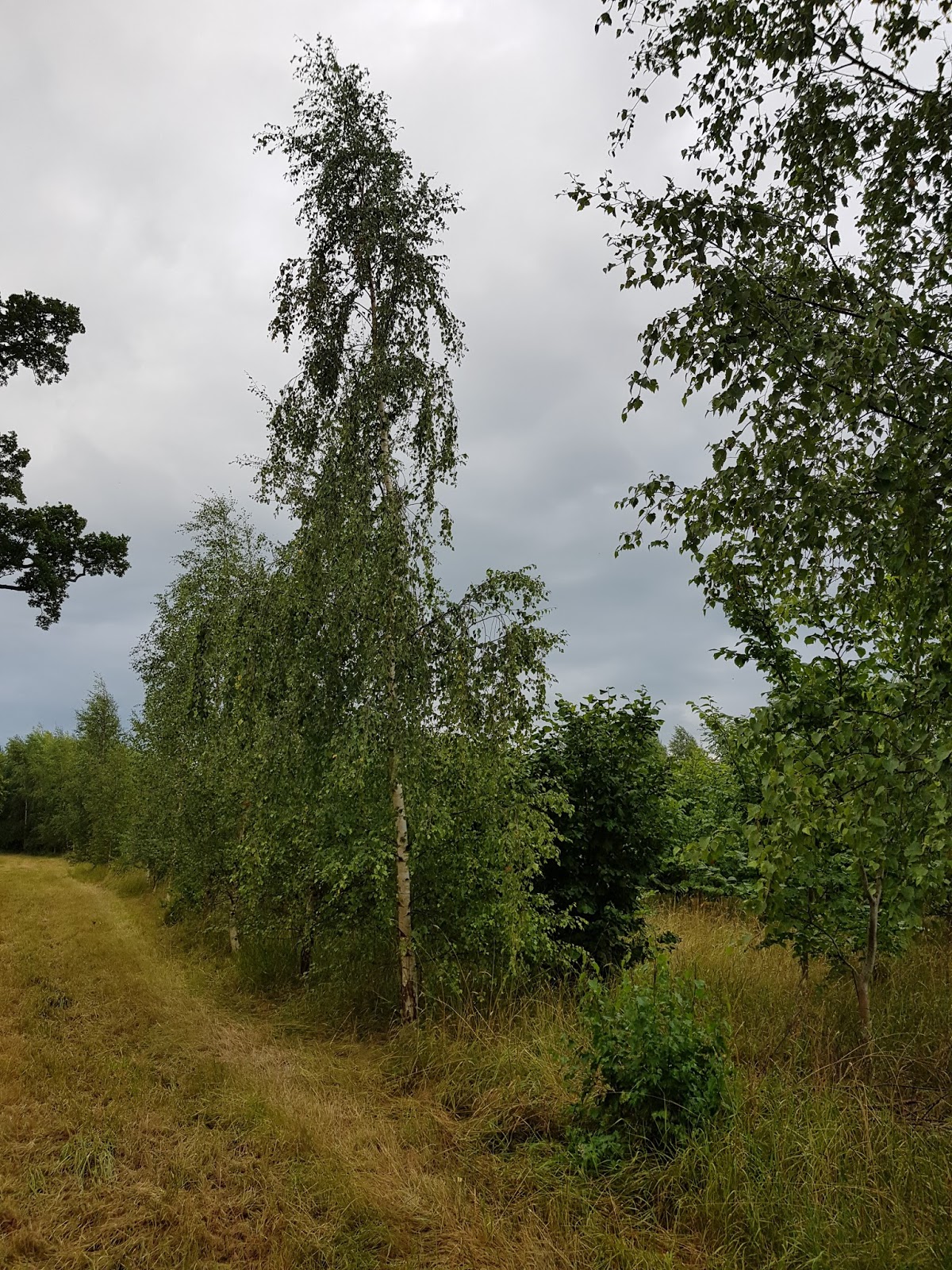
There are around 530 birch trees on the plot, mainly planted in a single row around the track edges.
Some are leaning due to the general wind direction.
I've started to coppice around every fithth tree (repeating on an approximate 5 year cycle), again to create multiple stems as regrowth.
On a long 'to do' list is making birch sap wine and birch sap syrup.


Footpath edge habitat enhancement (preparations) are ongoing. This is to make the Public Footpath more obvious and usuable throughout the year.
The increased width gives greater scope for varied vegetation margins and benefits for wildlife biodiversity.


Ash Die Back finally discovered by visual inspection. Classic symptoms and confirmed with dialogue and a sample sent to Forest Research as part of their monitoring scheme.


Monday, 6 February 2017

February 2017

An interesting week as January rolled into February.
The ground still a little damp underfoot, but a noticeable amount of fresh green growth in places and quite a bit of wildlife.
A couple of hosted visits...

The first was a small group of local villagers (instigated from concerns about perceptions of development).
I'd made a reasonable effort to bring some laminated cards of work scopes and conservation activities on the plot, classic habitat and woodland management guidance books, legislation details etc. that I work to, together with a tea-urn and sandwiches at a half-way point.
Unfortunately a member of the group was challenging from the start, interrupting any semblance of an introduction of myself, background, past projects and my view forward.
I was about to pack things up and go, but felt that despite most concerns being unconnected to myself, or being matters that would become self-evident, it was worth cutting the introduction and what had become an adversarial start, to moving through the site and try and move forward positively.
Within 100 metres things became more cordial and chatty by the time we got to the sandwiches.
Hopefully everyone went away with rumours quashed, genuine interest in what I do and an understanding of the balance of wildlife and productive trees on the plot.
Also, the guided walk hopefully draws a line under any local misgivings about the woodland and quashes any escalation to an unfounded rumours stage.
An extra bonus was the local village hall having an open night after refurbishment, later in the week and being able to chat informally to a couple of people who missed the chance to walk around.
Anyone is welcome to contact me to arrange a guided walk around, as well as being  able to preview the guidance notes to my Management Plan.

Work has been a little slow due to some external / home life priorities, but a few more hedging plants have gone in as replacements around the gateway.
Sourced from the excellent Maelor Forest Nursery - great to have such a professional resource on the doorstep for trees and hedging.
A little more brashing and pruning of side branches of trees, this serves two purposes as it helps form the trunk shape in later tree life, but I also use a tally counter to get a better idea of the trees on the overall site.

Another job is the slow steady coppice of some of the birch trees before the sap comes up with the onset of spring.
As the birch are mainly in a linear row around the track edges, I'm taking every 5th tree down to the stump. How the coppice regrowth performs, will give me an idea if a 5 year rotation is a bit too fast (1/5 of the 531 birch trees cut each year, then start again year 6).

Partial coppice of birch trees


The next visit was informal, a friend from the Wildlife Trust, particularly to consider Club Tail Dragonfly and habitat potential (dependent on silt characteristics in one of the ponds), or at least the trees which also fall into habitat aspects on their flight range.
Great additional dialogue regard hares, owls (and boxes to put up) and the balance between hedgerow management and the possibility of Dormice.
The latter have a good chance between rows of hazel along the west part of the footpath and brambles in the central ditch hedge. Ideas to maximise potential together with volunteers in the autumn for some hazel coppice regeneration.

Time was a bit short, but the value of an extra pair of experienced eyes can't be understated, particularly as aspects of overlap and integration with the wider landscape and other projects were discussed.

Wildlife seen and heard this week on site:-
Buzzard, Owls, Heron, Robin, Fox, Hare, Canada Goose, Mallard.

Sunday, 15 January 2017

Mid-January 2017

A damp and dark time of year, but fortunately not as damp as winter 2016 in respect to ground conditions!
For days when being outside isn't great, a chance to catch up on some admin and activities for the year ahead.

Woodland Management has cropped up in various contexts over the last couple of weeks with various people.
Firstly, I was reminded of a half day course put on by Plumpton College at their Flimwell Woodland Centre a few times a year. Excellent value at £30.

The dark winter nights gave me a push to update some guidance notes to my own Management Plan. These form part of a rating system on the well thought out myForest web pages, hosted by The Sylva Foundation.

Having replaced the gates on the plot before Xmas, some attention to the roadside hedge and replanting gaps is the next step, particularly around the entrance with some fresh grass seed and wildflowers.


Maelor Forest Nursery is a preferred choice for the hedging plants (and any tree restocking).

Unfortunately a sizeable existing hawthorn tree appeared to have become unsound...


Various degrees of decay in the upper branches, but it will (should...) sprout again from a shorter (and safer) stump.

  Another aspect of winter is being able to look around and through the tree canopy whilst the leaves are off.
A few instances of grey squirrel damage amongst the willows.


A leading shoot ring-barked where a squirrel has perched...


2 inches diameter where the bark and growing layer has been chewed, 8 feet long that has come down overall.

For the more welcome wildlife, I've seen a couple of hares again, but they are elusive when deliberately looking with a camera to hand.


Wednesday, 28 December 2016

2016

The end of 2015 saw a small trial of trees cut as coppice at the east end of the footpath. A rainy winter and wet ground conditions into early spring meant a slow paced start on areas of attention.

By spring 2016, the coppice stumps had started to sprout and a proper line of sight was reestablished for the footpath running east to west with some more trimming. As this path is also the widest point across the plot, it will also function as access for periodic work such as the coppice cycle to be established.

However, a significant scope of work this year is to turn this path into a functional 'green corridor' for wildlife.
At first (and during the first winter), it may appear brutal lanfscaping and a little bare.
Coppice cutting of the trees mainly on the east half of the path has taken place, to give around 6 metres width, within days barn owls were sweeping silently along its length, as well as hares being visible early mornings.
The coppice stumps will grow back along the path sides with bushy growth and give a varied height profile along the length of the path edges.
As each side of the path will have different light profiles (south side shaded by trees, north side edge of the path having warmer sun), this will give a varied habitat opportunity for wildlife and grasses and wild flowers.
The south side of the footpath has seen the start of a scrape ditch which will be partly shaded and hopefully good for amphibians and plants liking damp ground. The pathway will be an ongoing project well into 2017. Some reseeding with meadow grasses and appropriate native wild flowers to be done.
Although a straight line, the grass to the sides of the path will be mown alternately  in sweeping patches to enhance habitat diversity along a woodland edge.

A section of the roadside hedge has been layed,


with more to be done as time and the seasons of the year allow. (With thanks to North Wales Wildlife Trust hosting a hedgelaying training day as part of their wider Wrexham Industrial Estate projects).

The end of 2016 welcomes a new neighbour to the other side of the south boundary hedge and ponds, already a good working and communicative start.
Meanwhile in the village, the combination of a 'Sold' sign and a pair of replacement gates at the roadside has caused some concern and speculation regarding a housing development!
One villager took the trouble to come and ask what was happening here, they were unware I had been managing the plot for over 2 years - I'm not yet convinced that spurious rumours and concerns have been put to rest, as another villager mentioned the same incorrect development assumptions. (The convenants in my property deeds make any such development unlikely).
People are welcome to get in touch and arrange a site visit to discuss habitat and tree management 'work in progress' - meanwhile I'll be putting a couple of laminated notices along the path so that people can understand what the various workscopes and wildlife benefits are...

As a young woodland with trees planted around 11 years ago, some thinning is necessary, chainsaws will be heard and particularly with the coppice area, some open spaces will appear before the stumps resprout with new growth.


Monday, 28 December 2015

2015

Acquisition preliminaries and paperwork finalised towards the end of 2014, with 2015 mainly a year of observation and contemplation.

Stock proof fencing put in boundary gaps with the neighbour, some trimming, thinning and coppicing along the footpath to maintain a clear line of sight.
A preliminary woodland management plan on the drawing board, so that a balance can be struck long-term for wildlife conservation and woodland management.
A hay crop off the open grassland for the neighbour.

Generally, getting a feel for the plot, the overall nature of the place...

Saturday, 30 August 2014

2014

Finally, a handshake deal on a conservation woodland project.

Boundaries, legalities and other aspects to check, but hopefully moving forward with a balanced conservation minded and sustainable plot.